01 · NationalChip GX8002Noise reduction
On-board testLow-power real-time noise reduction for calls, voice and music, verified running continuously on a development board with the on-board analog microphone.
9.791 ms9.791 msSlowest full-chain frame in a 5-minute on-board run, within the 10 ms frame budget
7.167 ms7.167 msAverage processing time, down from 8.518 ms
0 frames0 framesOver the frame budget (20 before optimization); two runs of 30,000 frames each with no gaps, drops or bad packets
1.9–2.8 dB1.9–2.8 dBWhite-noise reduction within music on the 16, 24 and 48 kHz paths
Functions
- For calls and voice, bounded smooth attenuation lowers background sound in pauses while protecting weak speech, transients and the original timbre.
- For music, coherent 50/100 Hz or 60/120 Hz mains components are cancelled, and white noise and low-frequency fan noise are reduced per band.
- Supports 16, 24 and 48 kHz mono PCM16; the wideband music path runs every 10 ms with 16 ms of digital buffering.
On-board conditions: 24.576 MHz, 16 kHz mono on-board analog microphone, 5 minutes continuous. A 9 ms optimized candidate has passed digital audio-quality regression; its on-board timing and 10-minute stability are still to be verified. Noise reduction is computed against a fixed input-noise reference.
2.155 ms2.155 msAverage on-board NPU inference time, 2.163 ms maximum
6,000 / 6,0006,000 / 6,000Output blocks of a 96-second clip delivered within the 16 ms budget, with no output gaps
85.63%85.63%Voice / non-voice classification accuracy, up from 81.33%
82.62%82.62%Voice recall, up from 67.38%
Functions
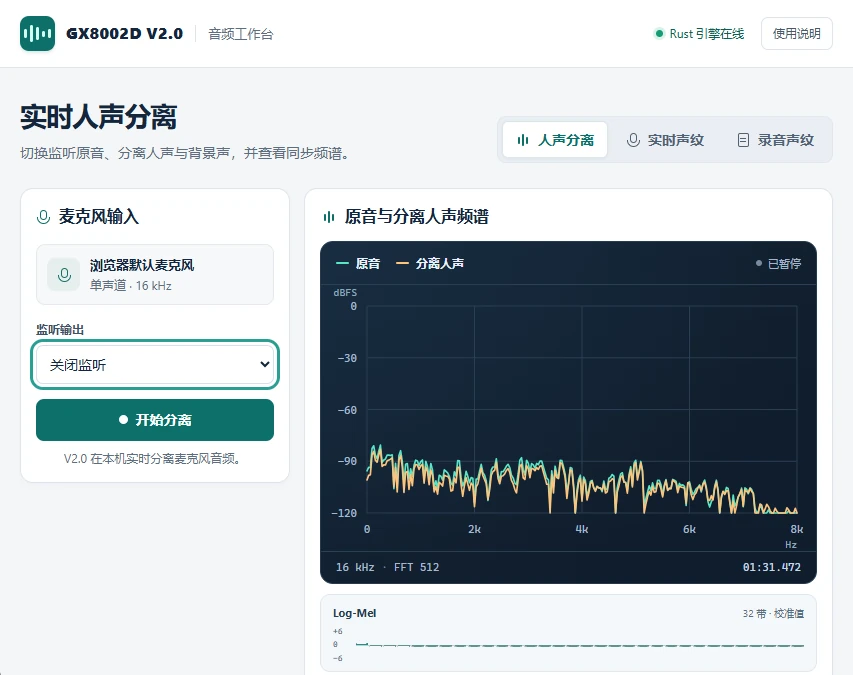
- Enhances voice in continuous single-channel audio, suppresses background noise and outputs enhanced PCM.
- Every 256 samples the GX8002D NPU infers 32 gain bands, with a causal classifier head deciding voice versus non-voice.
- 16 kHz mono PCM16 in and out; features are sent incrementally per frame and results are bit-exact reproducible.
The test chain runs a PC together with a GX8002D board: spectral features and audio reconstruction on the PC, NPU inference on the board. Digital end-to-end latency averages 33.28 ms (P95 40.51 ms), including the serial round trip, inference, classification and reconstruction, but not microphone capture or speaker playback.
0.20%0.20%False acceptance rate (FAR) on the test set, down from 3.77%
14.21%14.21%Equal error rate (EER), down from 26.36%
~38 KB~38 KBNPU model footprint; 18,592 projection parameters
0.999970.99997Minimum cosine similarity between chip-simulation vectors and the PC floating-point reference
Functions
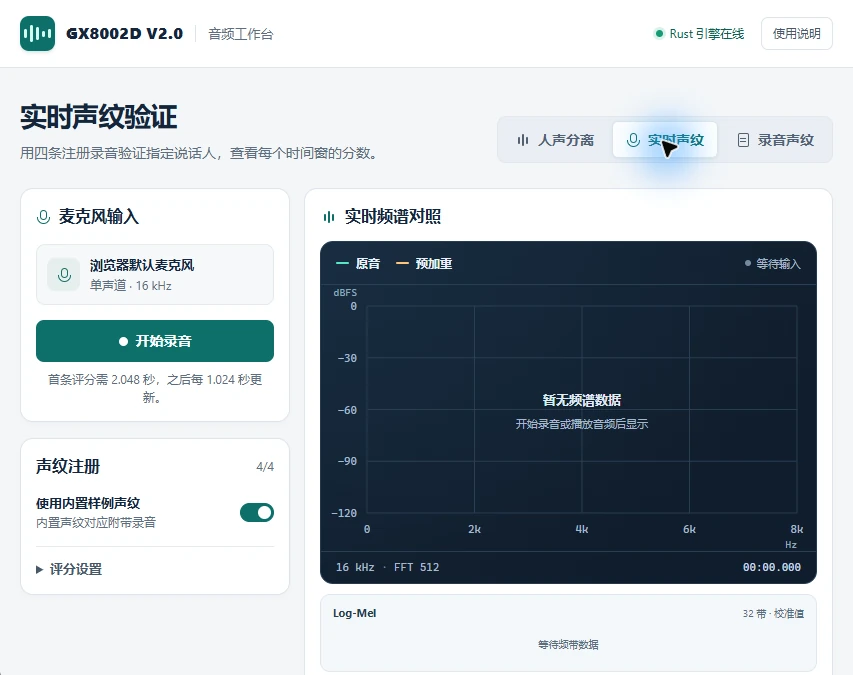
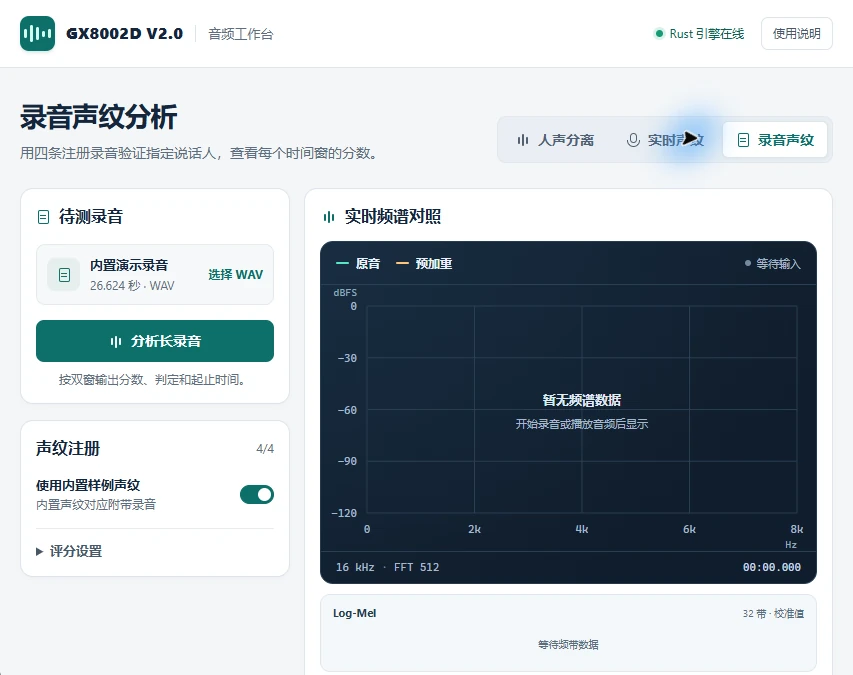
- 16 kHz mono PCM input in 1.024-second windows; the board extracts features and applies statistics pooling.
- A 128-dimension descriptor is projected in FP16 to a 64-dimension voiceprint vector, then L2-normalized.
- Each identity enrolls with two clean utterances; template cosine similarity and a calibrated threshold decide accept or reject.
These figures come from chip functional simulation on a public regression corpus, with the threshold locked at FAR ≤ 1% on a separate calibration set. V2 rejection is still high (test FRR 56.60%). 224 bench microphone recordings are captured; on-board inference is still being brought up, and FAR and noisy-condition rejection await hardware acceptance.
81.82%81.82%Pass rate in the core inner zone (0.60–0.90 m), 45/55, up from 72.73%
0.91%0.91%False passes beyond 1 metre, 1/110
264 / 264264 / 264Pass decisions matching between the C and reference implementations
16 ms16 msSDK frame length; four synchronized 16 kHz PCM16 inputs
Functions
- Within the candidate wake-word window, four synchronized microphones estimate near-field source distance and a 1-metre fence decides whether to pass.
- Fractional-delay correlation from six microphone pairs drives a search under a spherical propagation model; SRP-PHAT and sub-window consistency form distance, direction and signal-quality features.
- Wake-word source and geometry are checked first, then a 42-parameter weighted logistic regression produces the pass score.
This is a host simulation without a development board, and the core inner-zone pass rate has not yet reached the 95% target. DSP instruction execution, on-board timing and real-device wake rate still need measurement.
27 / 2727 / 27Core cases passing on host, Android 11 and Android 12
44BAP broadcast presets, 16 / 24 kHz LC3
±500 ppm±500 ppmController clock-drift models passing over one hour of virtual time
44Simulated receivers with LC3 decoding, join / leave and packet-loss recovery
Functions
- An Android control app starts, stops, pauses and resumes; input is a built-in test tone or a 48 kHz stereo WAV.
- Real LC3 encoding and decoding with 10 ms frames per channel; one BIG carries left and right on two BIS.
- Four broadcast presets — 16_2_1, 16_2_2, 24_2_1 and 24_2_2 — with an optional Broadcast Code for encryption.
- Controller capability checks, transmit clock synchronization, flow control and error cleanup.
Tests run on the host and a simulated controller, without real radio. Real headphone interoperability, range, interference resistance, acoustic latency and the full system image are not yet verified. Receivers must support Auracast / Broadcast Sink; ordinary A2DP headphones cannot receive the stream.
All figures come from internal test records under the conditions stated for each function; simulation results do not represent hardware performance. Real-world results depend on hardware, firmware, acoustic design and deployment. Chip specifications follow the manufacturer's documents for the exact variant.